Well, I did it, y'all. I made it through my first year of graduate school with dazzling success (as if anyone ever assumed I'd do anything but). In this, the semester from hell, wherein I took 15 hours, worked in the Writing Center, TAed 102, and still made time for bluegrass and cheap beer Thursdays, I feel like I did some really good work, achieved a lot of goals I'd set for myself, and had a great time along the way.
But, I ain't gonna lie to you, I'm thankful for summer, because I really need a break. I've already begun my first "for fun" book of the summer, Kevin Brockmeier's The Truth About Celia, and it's shaping up to be a really interesting read. He creates a fictional author who writes the novel in a series of inter-related short stories, which I love, because as of late I've become really fond of the short story genre. Heck, this summer, I might even try to write one or two.
I've also used the free time I've had the past week to work on some new poems, and I'm excited about a sexier one with a particularly striking image of an avocado. It's going on a really good direction, I think, and I'm hoping I can play around with form and try to figure out my own style. I think I've got my subject matter, at least my early twentysomething subject matter: I can write a hell of a witty and poignant white trash poem and sometimes, if I'm lucky, a queer love poem that doesn't get too sappy. I'm sending my first batch of stuff out on Monday, so I'll let you know in a few months if any journals decide to take a chance on a kid like me. Oh, I'm so excited about having more time to write.
Tonight I'm making cupcakes for an end of the year cookout one of my MA friends is throwing at his house. Lemon-cream cheese cupcakes that are going to be the best damned confections all the guests have ever eaten. That is, if they don't deflate when I pull them out of the oven.
To all of you still embroiled with finals-taking and paper-grading, godspeed. It'll be over soon, and then you'll have the summer to relax, and, here's a thought: come visit me! (winking at you, Abby).
To the start of summer!
Showing posts with label writing. Show all posts
Showing posts with label writing. Show all posts
Friday, May 2, 2008

Tuesday, April 22, 2008
Why I Decided to Write: Puberty, Poetry, and Sylvia Plath
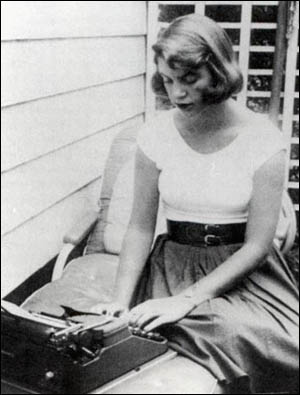
Taking a cue from my dear friend Josh's rumination on what drew him to writing poetry as a teenager, I've been thinking of my own coming to letters in my adolescence. I have to thank my 11th grade English teacher, Bonnie Reid. In her junior American lit class, students were assigned to choose an American poet and do a research project on that poet, including a report on his or her biography, an explication of a major poem, and a creative component--an artistic rendering of a poem, a book of our own creative work inspired by the poem, or, in my case, a food-related project. I wound up stuck (begrudgingly) doing my project on Carl Sandburg, so of course the poem I explicated was "Chicago," the one that begins "Hog butcher of the world." I made sugar cookie pigs iced with pink strawberry frosting. They weren't that cute.
I bet you're thinking that my project on Sandburg made me want to write, that good ol' Midwesterner Carl's work changed my young life. Well, not exactly. The truth is, I wanted to do my project on Sylvia Plath--because of the suicide mythos--but she was snatched up by a girl in my class before I could get my hands on her. I was resentful for a minute, and I decided I'd research Plath, too, so I could grill my classmate when she presented her Plath project.
What I found in my reading is that Plath spoke to me. I felt like the "terrible fish," and though my father and I always have gotten along, I, too, understood on some fundamental level the struggle to love a daddy you wanted to hate. "Dying is an art, like everything else," and Sylvia and I were in cahoots on that topic. I toyed with being stylishly depressed to the point of writing a few too many suicide poems when I was a teenager, probably because I was more inspired by Plath than I should have been.
Regardless of my emotionally over-wrought youth, I'm glad I spent significant time with Plath. In a time when I was sure I'd go to hell because of my sexual identity, when I wasn't sure if my parents would be able to love me anymore because of my recent coming out, when I felt alone in a world of people who would never understand me (show me a 17-year-old who doesn't feel that way), Plath's poetry spoke to me on a very fundamental level. I felt her struggle, because in a lot of ways, it was my struggle, too. I just wanted love, validation, legitimacy for an identity I didn't think then could ever be acceptable. Plath became a kindred spirit for me when no one understood me, and because of the time I spent with her work (I especially loved "Cut"), I decided I'd give poetry a shot, too.
So, I went to college and took a slough of creative writing classes, decided I enjoyed writing, and kept on doing it. That, as they say, was that.
Sure, I wrote before I found Plath--I've kept journals since I was about 12. And I toyed with writing poems the whole time. But Plath gave me a stake in the world of letters; she made me realize poems could be edgy, confessional, personal. She made it okay to be confused and sad, especially sad when I didn't know why I was. Though I'm not as into Plath now (nor am I nearly as emotionally over-wrought, thank God), I'm glad for those confusing, scary teen years and stumbling into Plath, because those experiences helped me stumble into being a writer. A serious writer. At least, that's what I'm trying to be.
So, thanks, Ms. Plath.
Sunday, March 9, 2008
Teaching Teen Poets
The UT Creative Writing Program has this event each Spring for area high school students called the Young Writers' Institute. From what I understand, students in the local public and private schools are nominated by their teachers to come take morning and afternoon workshops in different genres, free of charge. Man, where was a program like this when I was in high school?
I taught a free-verse poetry workshop to ten 14- and 15-year-old girls yesterday morning. I'm not lying y'all--it was the most fun I had all last week. These young writers were fantastic: motivated, interested (and interesting, which is always a plus), and really eager to learn something about writing. I opened up the workshop with a warm-up Write-Around-The-Room activity, which was a hit (it's always a hit). We got a great group poem about machine gods torturing pink rhinos. I explained to the writers that maybe these things could be metaphors--the machine gods might be wars or capitalism, the pink rhinos might be soliders or children. Or a team from Legends of the Hidden Temple.
After that we talked about Plath's "Metaphors," Brautigan's "All Watched Over By Machines of Loving Grace," and Marge Piercy's "Barbie Doll." I wanted them to see how poets take deeply personal, and even embodied experiences, like pregnancy in Plath's case, and attach the meaning to concrete objects outside of themselves to create specific images in their poems that are loaded with different levels of meaning. Then I did love-candy (Thanks, Monda!) and brought out my bag of tricks: a bag full of random things from around my house, including a blue bandanna, a miniature print of "American Gothic," a Barbie doll in a jar, a Jesus action figure, my Honors College medallion--just whatever. I had the writers draw objects and see how they could work together as images that form metaphors for the internal. One of the most interesting poems was by a girl who drew a can opener and a postcard that says "Free Love." She wrote about the mechanization of human emotion. An interesting line from her poem: "Red is vodka and sex." I love it, but I'm a bit concerned. She's 15. Sweet Jesus, please don't let her have any experience with "red."
I was so impressed by how eager they were to share their writing, and how friendly they were with each other. Without much prompting from me at all, these writers commented on their peers' work in very complimentary and helpful ways. By the end of the workshop, I had them all read at least one thing they'd written, laughing up a storm at my funny stories about New York subways and the awkward turtle hand gesture, and many of them asked me to read and comment on some of their earlier poems. I felt like a real teacher.
So I did get some angsty teenage poems about disillusionment and the "enormity of my hatred." But whatever. They're 9th and 10th graders. If they aren't surly teen poets now, God save them when they're writing howlers at 23. As long as they are writing and they are interested, I'm proud. I'm happy. These girls are writers.
On an interesting side note--Monda, this is particularly for you--at the open mic event at the end of the day, the students volunteered to read their work. Like I said before, we had all the different schools represented, and thus students from an array of socio-economic backgrounds. While I'm a dork and really get enthusiastic about any student writing, I'll be honest: The girls from Austin-East, Knoxville's poor, under-performing, inner-city school, were the most talented poets in the room. Phenomenal young talent--probably because they have real stuff to write about.
P.S.--My apologies to Josh and Charlotte for blathering on and on about my workshop yesterday afternoon. If I was rude, it was unintentional. I was just so damn excited. Next time just tell me to shut up, and I am excited to hear about yours.
I taught a free-verse poetry workshop to ten 14- and 15-year-old girls yesterday morning. I'm not lying y'all--it was the most fun I had all last week. These young writers were fantastic: motivated, interested (and interesting, which is always a plus), and really eager to learn something about writing. I opened up the workshop with a warm-up Write-Around-The-Room activity, which was a hit (it's always a hit). We got a great group poem about machine gods torturing pink rhinos. I explained to the writers that maybe these things could be metaphors--the machine gods might be wars or capitalism, the pink rhinos might be soliders or children. Or a team from Legends of the Hidden Temple.
After that we talked about Plath's "Metaphors," Brautigan's "All Watched Over By Machines of Loving Grace," and Marge Piercy's "Barbie Doll." I wanted them to see how poets take deeply personal, and even embodied experiences, like pregnancy in Plath's case, and attach the meaning to concrete objects outside of themselves to create specific images in their poems that are loaded with different levels of meaning. Then I did love-candy (Thanks, Monda!) and brought out my bag of tricks: a bag full of random things from around my house, including a blue bandanna, a miniature print of "American Gothic," a Barbie doll in a jar, a Jesus action figure, my Honors College medallion--just whatever. I had the writers draw objects and see how they could work together as images that form metaphors for the internal. One of the most interesting poems was by a girl who drew a can opener and a postcard that says "Free Love." She wrote about the mechanization of human emotion. An interesting line from her poem: "Red is vodka and sex." I love it, but I'm a bit concerned. She's 15. Sweet Jesus, please don't let her have any experience with "red."
I was so impressed by how eager they were to share their writing, and how friendly they were with each other. Without much prompting from me at all, these writers commented on their peers' work in very complimentary and helpful ways. By the end of the workshop, I had them all read at least one thing they'd written, laughing up a storm at my funny stories about New York subways and the awkward turtle hand gesture, and many of them asked me to read and comment on some of their earlier poems. I felt like a real teacher.
So I did get some angsty teenage poems about disillusionment and the "enormity of my hatred." But whatever. They're 9th and 10th graders. If they aren't surly teen poets now, God save them when they're writing howlers at 23. As long as they are writing and they are interested, I'm proud. I'm happy. These girls are writers.
On an interesting side note--Monda, this is particularly for you--at the open mic event at the end of the day, the students volunteered to read their work. Like I said before, we had all the different schools represented, and thus students from an array of socio-economic backgrounds. While I'm a dork and really get enthusiastic about any student writing, I'll be honest: The girls from Austin-East, Knoxville's poor, under-performing, inner-city school, were the most talented poets in the room. Phenomenal young talent--probably because they have real stuff to write about.
P.S.--My apologies to Josh and Charlotte for blathering on and on about my workshop yesterday afternoon. If I was rude, it was unintentional. I was just so damn excited. Next time just tell me to shut up, and I am excited to hear about yours.
Monday, January 14, 2008
Writing About Writing
In his article “Public Opinion and Professional Belief,” Carl Klaus calls for an interdisciplinary approach to the teaching of writing. Back in 1976, Klaus saw an inscrutable problem with the way composition was taught in the university classroom. Left to literature professors, writing pedagogy focused less on the process involved in effectively communicating ideas and more on the successful analysis of a literary text with regard to unquestioned rules about what constitutes good writing: grammar, mechanics, and usage. That's what happens when people who were taught that good writing is literature teach writing.
But there is a flaw in this model, and Klaus points to the teachers of writing to remedy the problem. Writing is not about literary analysis and an arbitrary system of grammatical rules. Such a system “isolates the use of language from the mental processes that give rise to it,” and what students are left with are professors with rulebooks and red pens who lack the pedagogical wherewithal to treat writing for what it is, a process (337).
An interdisciplinary approach to the teaching of writing removes the dated rulebook and replaces a write-or-wrong composition pedagogy with the understand that formulating and communicating ideas and experiences involves cognitive and developmental processes. A writing teacher should understand the social, psychic, and linguistic factors that a writer encounters when using language to relay experience. In other words, a 5-7 page argumentative essay assignment isn't what a student needs to learn how to write. The student of writing needs a professor who understands that even picking up a pen to write is a step in the process of the communication of ideas and experiences, that a lot more goes into writing that what our high school and college English teachers have led us to believe.
Ultimately, Klaus calls for the creation of the academic discipline of writing. In this arena, composition theories can be studied alongside pyscho-and sociolinguistics, rhetorical theory, and linguistic anthropology. Until this happens, Klaus argues that we teachers of writing are “at best dedicated amateurs, who for all our dedication may well be doing our students more harm than good” (338).
Klaus wrote this article over 30 yeas ago, and I wonder what has changed in the teaching of writing since. The first place I look to for a recognizable paradigm shift in writing pedagogy is my own undergraduate education and the ways in which I was taught to be a writer. By the time I hit the college scene in the fall of 2003, writing was on the map as an academic discipline, and unknown to me at the time I accepted the scholarship and moved off to the University of Central Arkansas, I was about to enter a setting in which writing was taught separately from literature within its own department housed in an entirely different college from English.
My first semester at UCA met me with the usual line up of general education requirements: theatre appreciation, a survey of world religions, and of course, freshman composition. I quickly learned that Comp II would be my easiest course because I was able to nail down the composition concept for each paper assignment: the personal essay, the argumentative essay, and the persuasive essay. I understood the components of a good paper, a clear thesis, topic sentences, and meaningful transitions, and I diplomatically argued in favor of repealing the recently-born P.A.T.R.I.O.T. ACT and convincingly persuaded my audience of the moral lessons taught in Harry Potter novels. All in all, I had a successful first semester college writing experience.
And then there was English. I declared English as a major early on, not because I necessarily loved literature, but because from my high school experience, I realized it was basically the only discipline I was pretty good at. In the English classroom I learned all of those age-old writing rules: avoid passive voice, don't begin a sentence with a conjunction, always place the thesis statement at the end of the first paragraph. I found success in such a strict writing environment, because as a young writer, I was more interested in writing for an A instead of writing for the sake of working out my ideas. Needless to say, I learned little about thinking for myself in the literature classroom.
Where reflection and self-discovery were encouraged, however, were in classes for my minor, which was Interdisciplinary Studies. Writing instruction in my IS classes was much different from the workshop model I learned in the creative writing classroom and the write-for-summary model I was taught in literature. Interdisciplinary Studies classes challenged me to look at specific issues in broader context, to question why culture accepted the paradigms it did. In the first survey course I took in the minor, Honors Core II: The Search for the Community, I was presented with lots of classic philosophical texts, from Heidegger to Hobbes, Plato to Kant, and I had to not only make heads or tails of the philosophy contained within their ideas, but also I had to come to my own conclusions about the way the world should work. I did a lot of growing, both emotionally and intellectually, in interdisciplinary studies courses, trying my hand at everything from religious studies, theories of gender, political philosophies, and scientific research.
The problem with the interdisciplinary model I was a part of, however, is that little emphasis was placed on the teaching of writing. Sure, I wrote papers, and sure, my professors gave me the best comments they could on them. The problem was I was being taught to write by professors who weren't writing teachers. They were philosophers, theologians, and historians. They were scientists and literature scholars who had different approaches to writing pedagogy, and none of them were consistent. Thank God for English, the department of one of my majors, because there I learned the down and dirty rules of good writing—the grammar, the structure, the mechanics—but I was rarely encouraged, or in some cases even allowed—to apply the critical thinking skills I learned in the interdisciplinary studies classroom to my literary analysis. No, I was taught, predominantly, that there is one way to look at a text, usually the way my professor looked at it, and any other approach was incorrect. Any hope of my own unique voice shining through in an English essay was squashed early.
And in stepped Writing, my second major. I love the creative writing classroom. I love the freedom to express my own ideas and the comfortable atmosphere of the workshop model. In poetry and fiction workshops, I learned that I have an important and unique voice, and it is important that I share it with the world. I would leave classes empowered as a writer thinking I could go out and change the world. The problem with feeling so great about my own writing is that I feel I was rarely exposed to what good writing is. In literature classes, I got that exposure. I read lots of good literary texts, and I learned how to analyze a poem for literary quality. However, I failed to make the connection that I could mimic technique in my own work, and sadly, in the creative writing classes I loved so much, I was rarely exposed to the world of contemporary poetry or criticism. So when I got to graduate school and took my first poetry workshop, I was under prepared for the type of reading and critical responses I was asked to do. Essentially, I had to re-learn how to be a valuable workshop member.
I do not wish to knock my writing education too hard. I learned very important aspects of the writing process in the classes of each of my majors and minors. What I wish I would have had the direction to do (or the smarts to see for myself) is how I could take everything I learned about critical thinking, technical precision, and voice and incorporate them into my writing process for all classes. I was stifled by departmental divides and learned to write a certain way for each class, which got me a summa cum laude BA, but set me up for a rude awakening once I began writing at the graduate level.
Thursday, January 10, 2008
So Long, Smartie Pants
My brain has turned to complete mush. Mush, I tell you. Guess that's what I get for taking a month off from pursuing anything intellectually challenging or creatively stimulating. Over the break I watched hours and hours of America's Next Top Model, slept til noon, and drank beer with my high school friends in lieu of doing anything to keep my intellectual juices flowing. It was fun at the time, but now school's started back up, and I might freak out. I think it's safe to say that Tim had a bad day.
I mean, it wasn't terrible, just nerve-racking. It was one of those days where you fail to answer to your given name when it's called on the roll because Timothy sounds so foreign to you, when, try as you might, you can't make yourself write "08" instead of "07" when you date the top of the page. Even a simple reading assignment (and I'm talking simple--maybe 10 pages) is so daunting, so utterly discombobulating, the words on the page just jumble together in a mess. And I'm not under the influence of any mind-altering drugs. I'm just coming out of a lethargic period. Let's hope I bounce back soon. I'm taking four grad classes this semester and starting a new job as a private English and history tutor for a high school junior. I'm wondering if that's too much....but then I remember those wonderful undergraduate years when I had no problem balancing a 22-hour semester, editing The Vortex, working at Subway and the Writing Center and still going out every weekend. I fear those days may be behind me now.
What I need is some motivation, a good day in class, a good start on a poem. Instead I have a knot of nerves below my stomach about how poorly I'm afraid I'll do this semester, and the poem I tried to write last night was ended mid-line to save the world from another surly teenagerish whine fest. But I'll keep on hacking, I guess. That's what a writer's gotta do, right?
Back to the grindstone.
I mean, it wasn't terrible, just nerve-racking. It was one of those days where you fail to answer to your given name when it's called on the roll because Timothy sounds so foreign to you, when, try as you might, you can't make yourself write "08" instead of "07" when you date the top of the page. Even a simple reading assignment (and I'm talking simple--maybe 10 pages) is so daunting, so utterly discombobulating, the words on the page just jumble together in a mess. And I'm not under the influence of any mind-altering drugs. I'm just coming out of a lethargic period. Let's hope I bounce back soon. I'm taking four grad classes this semester and starting a new job as a private English and history tutor for a high school junior. I'm wondering if that's too much....but then I remember those wonderful undergraduate years when I had no problem balancing a 22-hour semester, editing The Vortex, working at Subway and the Writing Center and still going out every weekend. I fear those days may be behind me now.
What I need is some motivation, a good day in class, a good start on a poem. Instead I have a knot of nerves below my stomach about how poorly I'm afraid I'll do this semester, and the poem I tried to write last night was ended mid-line to save the world from another surly teenagerish whine fest. But I'll keep on hacking, I guess. That's what a writer's gotta do, right?
Back to the grindstone.
Monday, November 12, 2007
It's a sensation
This is interesting. I stole it from Steph's site. It's the latest Arkansas Literary Forum with three non-fiction pieces by Damien Echols, a kid sentenced to death after the West Memphis 3 murders 14 years ago. Man, I was 8-years-old when that happened. I grew up in a town that bordered West Memphis, Arkansas, to the west, and I remember the flood of new students who came to my elementary school, their parents hoping twenty miles and a Mississippi address would save their precious babes from Satan-worshiping goth teenagers on the prowl for small children. It's crazy how sensationalism works in the small town South. Mention the word "Satan" or "Wiccan" (or "Muslim" or "homosexual") and people lose all capacity for reason and throw their good sense out the pick up truck's sliding cab window.
Maybe I'm being too hard on my beloved South. I've never lived anywhere else (though, if you ask me, Knoxville's not the South), so I don't have any experience to offset my opinion of the way the Bible belt tightened its hold on the media and refused to paint those boys, especially Echols, any other way but downright evil, all because they were some underprivileged and confused teenagers who liked to wear black and probably smoke a little dope. If that's grounds for the death penalty, a handful of my buddies from high school should be up for an appeal pretty soon.
What's done is done, I guess, though I hate to take such a lackadaisical stance. Check out Echols's story about living on death row. Not the best writing I've ever read, but interesting nonetheless. While you're at it, check out the stories by the dynamic duo, John and Stephanie Vanderslice. They were my teachers for many, many classes.
Does anyone know (Steph, Monda?) if one has to be a current Arkansas resident to publish in the ALF? If we can get around the residency issue (and the fact that I'm not Arkansan by birth, but by choice), I'm interested in submitting some of my stuff.
Maybe I'm being too hard on my beloved South. I've never lived anywhere else (though, if you ask me, Knoxville's not the South), so I don't have any experience to offset my opinion of the way the Bible belt tightened its hold on the media and refused to paint those boys, especially Echols, any other way but downright evil, all because they were some underprivileged and confused teenagers who liked to wear black and probably smoke a little dope. If that's grounds for the death penalty, a handful of my buddies from high school should be up for an appeal pretty soon.
What's done is done, I guess, though I hate to take such a lackadaisical stance. Check out Echols's story about living on death row. Not the best writing I've ever read, but interesting nonetheless. While you're at it, check out the stories by the dynamic duo, John and Stephanie Vanderslice. They were my teachers for many, many classes.
Does anyone know (Steph, Monda?) if one has to be a current Arkansas resident to publish in the ALF? If we can get around the residency issue (and the fact that I'm not Arkansan by birth, but by choice), I'm interested in submitting some of my stuff.
Thursday, November 1, 2007
Marriage and the lyric problem
I know two twenty-year-olds who plan on becoming engaged, but they aren't engaged. Essentially, they are engaged to be engaged. Am I missing something? I'm not engaged, nor do I plan on becoming engaged any time soon (that would require a willing party to consent to my marriage proposal, after all), but I think if I were looking toward the future, I might think about asking someone to marry me. I might plan it out and weigh my options, and I might even discuss marriage with that person. But announcing to the world--and expecting cheers and congratulations--for planning on promising to marry someone but not promising yet? Give me a break.
My thinking about marriage comes as a result of class tonight. My mind wanders, even in classes I really enjoy (looks I've incriminated myself to my past teachers who read this blog), and as I gazed around the room, I realized something: I was the only non-married (or long-term committed) person sitting at the table. Not that that changes how I perform in the class, but it's something to think about. I wonder how marriage informs my classmates' writing. Husbands/wives/significant others have appeared in at least three people's poems that I can remember. I also remember really liking those poems, the ways they dealt with the problem of people. If living in the world with with other people is an issue that complicates the lyric, I wonder what living in a house with another person with whom you share life, love, and a last name does to the writer of the lyric.
My poetry, not surprisingly, is self-interested. I write a lot about what's going on with me, how other people's words and actions bear upon my life. What's at stake, in my life and in my writing, is something internal, like a struggle to find and voice a meaning for who I am as an individual. When I write about other people, like my mother or my grandmother or a woman I over hear spouting anti-feminist rhetoric on the street, what I'm doing is working through how they affect me in some way. I'm not sure I've yet written about how my life acts as an agent to affect change in another's. I wonder if marriage makes the writer understand more clearly her role in a community of selves with power to influence another. I sure have heard enough people talk of the ways becoming a parent informs their identity and their writing, and I wonder if being married does something similar.
All that said, I don't think my voice is self-serving, nor do I think only married poets write the best lyrics. I'm just interested in the lyric mode and its function of dealing with the self in relation to others and how someone in a committed relationship with another approaches the problem with people differently than a single person.
Any ideas, recommended reading, or "stop thinking so much, Tims" would be greatly appreciated.
My thinking about marriage comes as a result of class tonight. My mind wanders, even in classes I really enjoy (looks I've incriminated myself to my past teachers who read this blog), and as I gazed around the room, I realized something: I was the only non-married (or long-term committed) person sitting at the table. Not that that changes how I perform in the class, but it's something to think about. I wonder how marriage informs my classmates' writing. Husbands/wives/significant others have appeared in at least three people's poems that I can remember. I also remember really liking those poems, the ways they dealt with the problem of people. If living in the world with with other people is an issue that complicates the lyric, I wonder what living in a house with another person with whom you share life, love, and a last name does to the writer of the lyric.
My poetry, not surprisingly, is self-interested. I write a lot about what's going on with me, how other people's words and actions bear upon my life. What's at stake, in my life and in my writing, is something internal, like a struggle to find and voice a meaning for who I am as an individual. When I write about other people, like my mother or my grandmother or a woman I over hear spouting anti-feminist rhetoric on the street, what I'm doing is working through how they affect me in some way. I'm not sure I've yet written about how my life acts as an agent to affect change in another's. I wonder if marriage makes the writer understand more clearly her role in a community of selves with power to influence another. I sure have heard enough people talk of the ways becoming a parent informs their identity and their writing, and I wonder if being married does something similar.
All that said, I don't think my voice is self-serving, nor do I think only married poets write the best lyrics. I'm just interested in the lyric mode and its function of dealing with the self in relation to others and how someone in a committed relationship with another approaches the problem with people differently than a single person.
Any ideas, recommended reading, or "stop thinking so much, Tims" would be greatly appreciated.
Subscribe to:
Posts (Atom)


